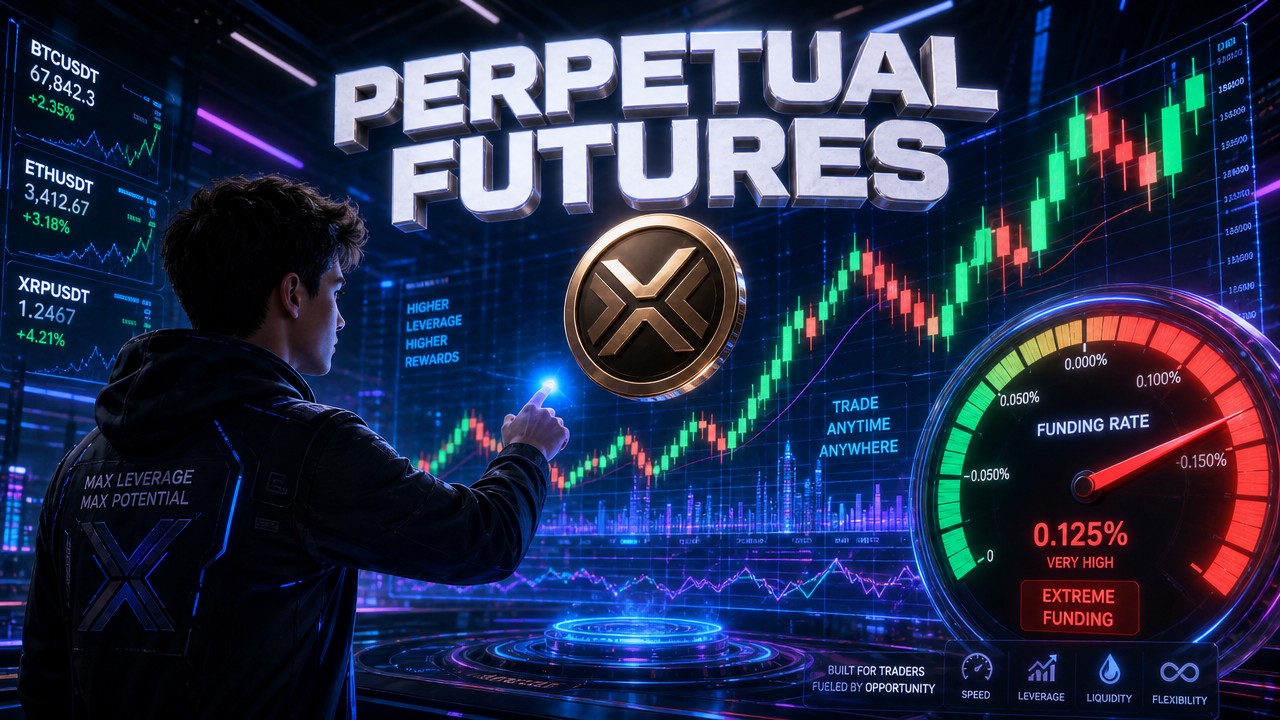

What Is a Perpetual Futures Contract?
A perp is a leveraged derivative that mimics spot price — with no expiry date.
Traditional futures contracts (like CME Bitcoin futures) have a fixed expiration date — typically monthly or quarterly. At expiry, the contract settles and closes. Perpetual futures have no expiry. You can hold a position for minutes or years — there's no forced settlement.
Instead of expiry, perps use a funding rate mechanism — a periodic fee paid between longs and shorts every 8 hours — to keep the perp price tethered to the spot market price. When the perp trades above spot, longs pay shorts. When it trades below spot, shorts pay longs.
Perpetual futures were invented by Arthur Hayes at BitMEX in 2016. They are now the most traded crypto product globally — dwarfing spot volumes on every major exchange.
Key Characteristics of Perps
Expiry
None
Funding
Every 8h
Leverage
Up to 125x
Invented
BitMEX 2016
Perpetual Futures vs Spot Trading
Spot is buying the coin; perps are a contract on price with leverage — no coin ownership.
Spot Trading
- You own the actual asset (1 BTC = 1 BTC)
- No leverage — $100k needed to buy 1 BTC
- No funding costs, no liquidation risk
- Can stake/earn yield on held assets
- Profit only when price rises
- Lower risk, lower potential return
Perpetual Futures
- You hold a contract, NOT the coin
- $1k at 10x = $10k BTC exposure (0.1 BTC)
- Funding cost every 8h on full position
- Liquidation risk — can lose 100% of margin
- Profit in both rising AND falling markets (short)
- Higher risk, capital-efficient, shorting available
How Leverage Works
Leverage multiplies both gains and losses by the chosen ratio.
With $1,000 USDT at 10x leverage, you control a $10,000 position. That's equivalent to 0.1 BTC at $100,000. Now:
- BTC rises 5% → position gains $500 → +50% on your $1,000 margin
- BTC falls 5% → position loses $500 → -50% on your $1,000 margin
- At 100x: 1% adverse move = 100% loss → liquidation
Leverage Impact on $1,000 USDT Position (BTC at $100,000)
| Leverage | Position Size | +5% BTC | -5% BTC | Liq. % Move |
|---|---|---|---|---|
| 2x | $2,000 | +$100 (+10%) | -$100 (-10%) | -50% |
| 5x | $5,000 | +$250 (+25%) | -$250 (-25%) | -20% |
| 10x | $10,000 | +$500 (+50%) | -$500 (-50%) | -10% |
| 25x | $25,000 | +$1,250 (+125%) | -$1,000 (-100%) | -4% |
| 100x | $100,000 | +$5,000 (+500%) | -$1,000 (-100%) | -1% |
Funding Rate
A fee paid every 8h between longs and shorts to keep perp price aligned with spot.
Without a mechanism to anchor the perp to spot, the two prices would diverge indefinitely. The funding rate is that mechanism. Here's how it works:
Bullish Market (Perp > Spot)
- Perp price above spot = longs pay shorts
- Incentivizes new shorts, discourages new longs
- Pushes perp price back toward spot
- Typical bull rate: 0.01%–0.05%/8h
- Extreme bull spike: 0.1%+/8h
Bearish Market (Perp < Spot)
- Perp price below spot = shorts pay longs
- Incentivizes new longs, discourages new shorts
- Pushes perp price back toward spot
- Negative rates common during bear markets
Funding Rate Math — Real Example
Position size: $10,000 USDT (10x on $1,000 margin)
Funding rate: 0.01% per 8h
Funding paid = $10,000 × 0.01% = $1.00 per 8h
= $3.00/day = $90/month = ~10.95% annualized on position size
Note: Funding is on the FULL position size ($10k), NOT on your margin ($1k)
Mark Price vs Last Price
Mark price is the fair value used for liquidations; last price is the actual trade price.
This is a critical distinction that every perp trader must understand. Last price = the actual price of the most recent trade on that exchange. Mark price = a fair value calculated from the index price (average of multiple major spot exchanges) plus a funding basis component.
Liquidations trigger at mark price — not last price. This protects traders from being unfairly liquidated by a wick on a single exchange. If Bybit's last price briefly spikes down 5% due to a large sell order, but the mark price (based on the global index) barely moves, you will not be liquidated.
Last Price
The price of the most recent executed trade on the exchange. Can wick temporarily due to a single large order.
Used for: Determines your PnL display.
Mark Price
Index of multiple spot exchanges + funding basis. Smooth, manipulation-resistant. Cannot be spiked by a single order.
Used for: Triggers liquidations and stop-losses.
Index Price
Weighted average of the same asset across major spot exchanges (Binance, Coinbase, etc.). The base reference.
Used for: Used to calculate mark price.
Pro tip: Always set your stop-loss orders based on mark price, not last price. On Bybit and OKX this is a toggle in the order form — set it once and it stays set.
Liquidation — How It Happens
Liquidation triggers when losses consume your margin minus maintenance margin.
When your margin balance falls below the maintenance margin threshold (typically 0.5%–1% of position), the exchange automatically closes your position and keeps your remaining margin. You lose everything in your isolated margin for that trade.
Liquidation Price Formula (Simplified)
For a LONG position:
Liq Price ≈ Entry × (1 - 1/Leverage + Maintenance%)
Example: Long $10k BTC at $100,000 with 10x leverage (maintenance 0.5%)
Liq ≈ $100,000 × (1 - 0.1 + 0.005) = ~$90,500
5x
Entry: $100,000
Liq: ~$80,900
(-19.1% move)
10x
Entry: $100,000
Liq: ~$90,500
(-9.5% move)
25x
Entry: $100,000
Liq: ~$96,200
(-3.8% move)
Isolated vs Cross Margin
Isolated risks only the allocated amount; cross uses your full account balance.
Isolated Margin
Recommended for beginners
- Only the margin you allocate is at risk
- Max loss = your allocated margin (e.g., $1k)
- Other positions unaffected if this trade liquidates
- Higher liquidation risk (less margin buffer)
Cross Margin
For experienced traders
- All positions share your full balance as margin
- Lower liquidation risk (more margin buffer)
- Capital-efficient for multi-position strategies
- One bad trade can liquidate your entire account
Long vs Short
Long profits if price rises; short profits if price falls.
Long (Buy)
- You open by buying, close by selling
- Profit when price rises above your entry
- Loss when price falls below entry
- Liquidation if price drops too far
Short (Sell)
- You open by selling, close by buying
- Profit when price falls below your entry
- Loss when price rises above entry
- Liquidation if price rises too far
Order Types
Market, limit, stop-loss, take-profit are the four core order types you need.
Market Order
Instant execution at current market price. You pay the taker fee (0.055% on Bybit). Use when speed matters — entering breakouts, exiting fast.
⚠ Can have slippage in thin markets
Limit Order
Set your exact entry or exit price. Only fills if market reaches your price. You pay maker fee (0.02% on Bybit) — cheaper than market.
✓ Lower fees, but not guaranteed to fill
Stop-Loss (SL)
Triggers a market close when price hits your stop level. Set on mark price. Protects you from large losses. Always set BEFORE entering a trade.
⚠ May slip in flash crashes
Take-Profit (TP)
Automatically closes your position at your target profit level. Lets you lock in gains without watching the screen. Set simultaneously with SL.
✓ Removes emotion from exits
Real Trade Example
$1,000 long on Bybit BTC perp at 10x — step by step.
Trade Setup
BTC Price
$100,000
Margin
$1,000 USDT
Leverage
10x
Position
$10,000 (0.1 BTC)
Stop-Loss
$97,000
-3% price = -30% margin = -$300
Take-Profit
$106,000
+6% price = +60% margin = +$600
Liquidation Price
~$91,000
-9.5% from entry (mark price)
Scenario A: TP Hit at $106,000
Gross profit: +$600
Entry fee (0.055% taker): -$5.50
Exit fee (0.055% taker): -$5.83
Funding (1 day held × 0.03%): -$3.00
Net: +$585.67 (+58.6%)
Scenario B: SL Hit at $97,000
Gross loss: -$300
Entry fee: -$5.50
Exit fee: -$5.35
Funding (held few hours): -$0.50
Net: -$311.35 (-31.1%)
Fees
Total cost = entry fee + exit fee + funding held + slippage.
| Cost Component | Formula | On $10k Position |
|---|---|---|
| Entry fee (taker) | 0.055% × position | $5.50 |
| Exit fee (taker) | 0.055% × position | $5.50 |
| Round-trip fees | 0.11% total | $11.00 |
| Funding (1 day) | 0.01%/8h × 3 × $10k | $3.00 |
| Slippage (BTC) | ~0.01-0.05% per side | $1–$5 |
| Total (1-day hold) | Fees + 1d funding + slip | ~$17–$24 |
Risks
Leverage amplifies losses. Liquidation can wipe your account in minutes.
Cascade Liquidations in Flash Crashes
When BTC drops fast, many leveraged longs get liquidated simultaneously — their forced market sells push price lower, triggering more liquidations. In March 2020, $1B+ was liquidated in minutes. Even conservative leverage positions can get caught.
Funding Erodes Profits Over Time
Holding a long during a bull run costs 0.01%+/8h in funding. At 0.1%/8h (extreme bull), that's 0.3%/day on your full position size — on a $10k position, $30/day. After 2 weeks, you've paid $420 in funding even if price doesn't move.
Exchange Insolvency / Hack Risk
Bybit's February 2025 hack reminded everyone: exchanges can be compromised. Always trade with funds you can afford to lose. Verify Proof of Reserves monthly. Never keep more than you're actively trading on any single exchange.
Emotional Over-Trading
The biggest killer of perp traders is psychology — revenge trading after a loss, doubling down on losing positions, removing stop-losses. Never risk more than 1–2% of your total capital per trade. Pre-define your SL before entering.
Best Exchanges for Perpetuals
Bybit leads liquidity; MEXC wins fees; OKX wins security.
0.055% taker · 125x max · 1,200+ pairs · 87ms execution
Deepest BTC/ETH liquidity outside Binance. Built-in copy trading & bots. Best mobile app in the industry.
0.02% taker · 0% maker · 500x max · 1,400+ pairs
Lowest fees in the industry. Best for altcoin perps and high-frequency traders minimizing costs.
0.05% taker · 125x max · Merkle-tree PoR · Never hacked
Best-in-class security transparency. Merkle-tree Proof of Reserves published monthly. Strong DeFi integration.
FAQ — Perpetual Futures
Most common questions answered.
Ready to Trade Perpetual Futures?
Start on Bybit — best liquidity, built-in bots, copy trading, and the clearest UI for learning perps.
Open Bybit Account — Up to $30k Bonus⚠ Derivatives trading involves significant risk. Never invest more than you can afford to lose.
Risk Warning: Perpetual futures are complex leveraged instruments and involve a high level of risk. You can lose all of your margin rapidly. This content is for educational purposes only and does not constitute financial advice. Past performance is not indicative of future results. Ron Nguyen may receive compensation from exchanges via affiliate links on this page. Affiliate disclosure →